
That "Smart" Software Might Not Be as Smart as You Think
You've heard the buzz around artificial intelligence. It's everywhere, promising to revolutionize how you run your business. But with all the hype, it’s easy to get confused about what AI actually is and how it’s any different from the software you’re already using.
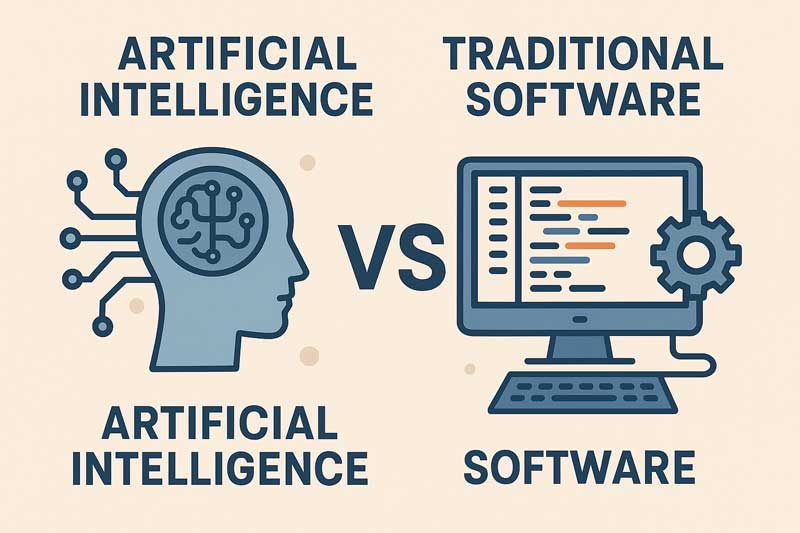
This confusion is a huge problem. I’ve seen too many business owners either invest in the wrong technology because it had "AI" slapped on the label or miss out on game-changing opportunities because they thought it was all just marketing fluff.
Let’s clear this up so you can make smart decisions for your business.
What is Traditional Software?
Think of traditional software as a very obedient but very literal employee. You give it a set of specific instructions (the code), and it follows them to the letter. If you tell it to take customer data from a form and save it to a spreadsheet, it will do exactly that, every single time.
But that’s all it can do. It can’t handle anything it wasn’t explicitly programmed for. If a customer enters their phone number in the wrong format, the software will likely either reject it or save the incorrect data, because no one told it what to do in that specific scenario. It’s reliable for predictable, repetitive tasks, but it has no ability to learn or adapt on its own.
What Makes Artificial Intelligence Different?
This is where it gets interesting.
AI is designed to mimic human intelligence. Instead of just following a rigid set of instructions, it can learn, reason, and make decisions.
Imagine you could hire an employee who gets smarter and more efficient at their job over time without you having to train them on every single detail. That’s the power of AI. You don't give it a list of commands; you give it data, and it learns from that data to achieve a specific goal.
For example, an AI-powered customer service bot doesn't just respond with pre-written answers. It analyzes the customer’s question, understands the intent behind it (even if it’s phrased unusually), and provides the best possible answer based on its past interactions. And it gets better and more accurate with every conversation it has.
Aspect | Traditional Software | Artificial Intelligence (AI) |
|---|---|---|
How it Works | Follows explicit, pre-programmed rules. | Learns from data to make predictions and decisions. |
Flexibility | Rigid. Can only do what it's programmed to do. | Adaptive. Can handle new and unexpected situations. |
Improvement | Requires a developer to manually update the code. | Improves on its own as it's exposed to more data. |
Example | A standard calculator that always gives the same answer for 2+2. | A navigation app that analyzes traffic data in real-time to find you the fastest route. |
Practical Examples
Traditional Software:
Artificial Intelligence:
A Quick Word of Caution: The Realism of AI
While AI is powerful, it’s not perfect. Because AI learns from data to make predictions, its output is based on probabilities, not certainties. This means an AI’s answer is not always 100% accurate.
AI output always needs a human touch for verification, especially when the stakes are high. This isn’t a weakness; it’s simply the nature of the technology and why having a strategy for how you use it is so important.
Why You Should Care
Understanding the difference is important because it helps you spot the right opportunities for your business.
If you have a straightforward, unchanging task, traditional software might be what you need. But if you're trying to solve a more complex problem that involves understanding patterns, predicting outcomes, or adapting to new information, then you should be looking at AI.
Don't let the "shiny object syndrome" distract you from what really matters: finding the right tool for the job.
By understanding the fundamental difference between AI and traditional software, you're already in a much better position to leverage technology to grow your business without needing to become a tech expert yourself.
